
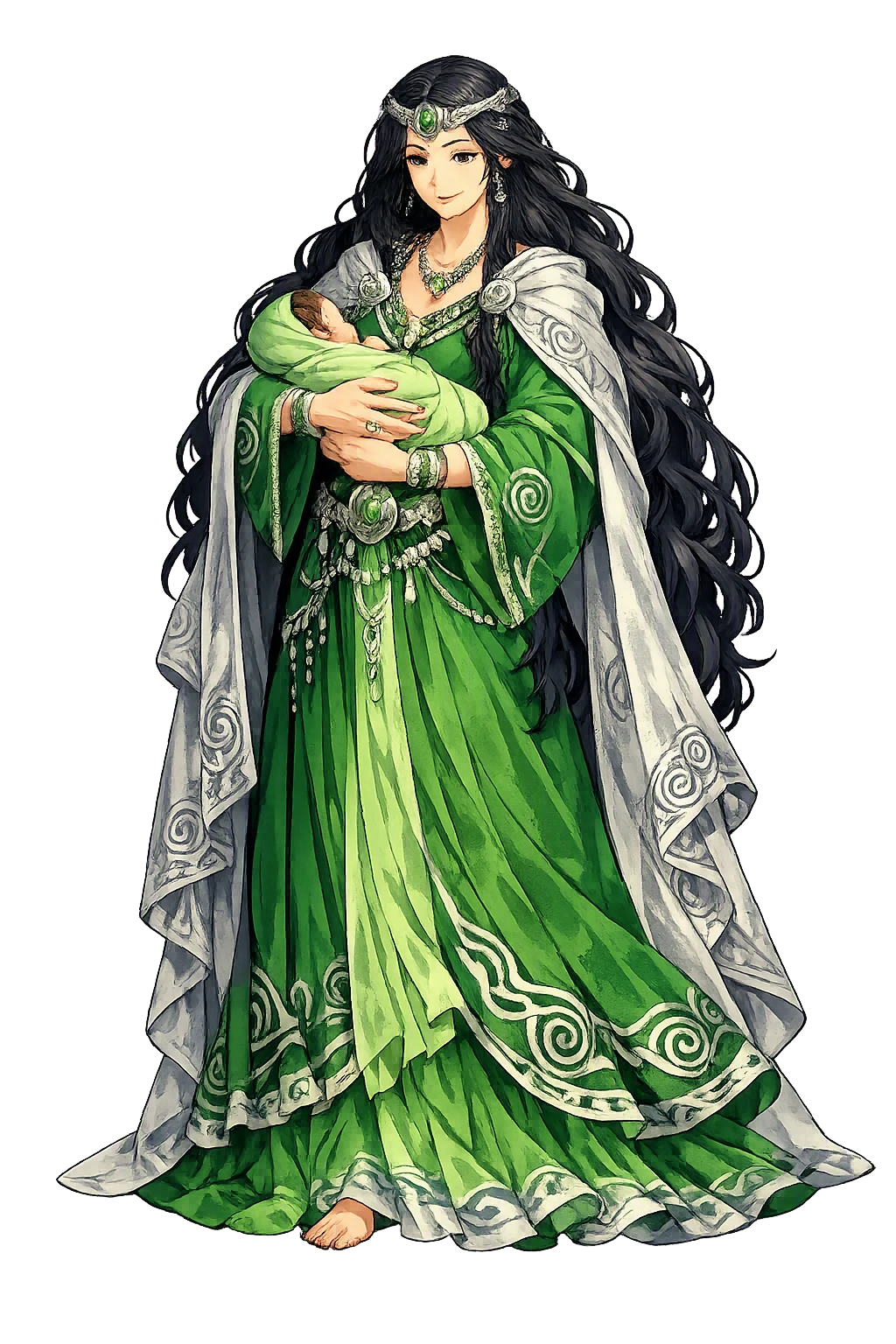
Pronouncing Don: a guide for the curious
Saying Don aloud is harder than reading it on a screen, and more rewarding. The restored spelling is a compressed pronunciation guide: every accent and macron is an instruction. This post unpacks those instructions — the reconstructed sound, the phoneme-by-phoneme record, the kindred forms in neighboring languages — and then zooms out to the full record around the name: its Celtic transcription writing, its mythology, its cult, and its modern life as a Unicode domain. Whether you arrive as a linguist, a reader of myth, or a domainer, you will leave able to say the name the way the evidence suggests it was said — and able to type it the way it was written.
At a Glance
- Restored name: Don
- ASCII form: don
- Meaning: "Goddess"
- Domain of influence: Mother of Gods
- Pantheon: Celtic
- Classification: Tier 2
Overview
Don (don) — Mother of Gods · Goddess — is the matriarch of the Mabinogi's magical house: sister of Math fab Mathonwy, lord of Gwynedd, and mother of the kindred the Welsh tradition called Plant Dôn, the Children of Dôn — Gwydion the enchanter, Gilfaethwy his brother, Arianrhod ferch Dôn, Gofannon the smith, and Amaethon the ploughman. She is the only major figure of the Four Branches who never speaks, acts, or appears: the whole of the Fourth Branch, Math fab Mathonwy, unfolds among her children and her brother, and she is present only in the matronymics they carry — uab Dôn, son of Dôn; uerch Dôn, daughter of Dôn.
The name's etymology is genuinely unsettled. The lexicon's traditional gloss is 'Goddess', reflecting the standard derivation from Common Celtic dēwā, 'goddess' — the same word the Welsh language preserves in Dyfrdwy, its name for the River Dee; a river-name origin is also argued, and the handbooks leave the question open. The long-standing comparison with the Irish Danu, mother in name of the Túatha Dé Danann, is registered by the reference works as typological, not genealogical.
PuniCodex restores the name as Don — identical to the ASCII input, because the Middle Welsh manuscripts write the name in plain Latin letters and the circumflex of modern Welsh Dôn is a modern length-mark, not a letter the manuscripts carry; the name is Tier 2 by the mechanical rule. No domain is claimed: the plain-ASCII don.com is registered to a third party outside the collection and is watched for release.
The Name
The name is attested in Middle Welsh as Don, matriarch of the northern divine house, in the Fourth Branch of the Mabinogi and in Culhwch ac Olwen — always in the matronymic: Gwydion uab Dôn, Gilfaethwy uab Dôn, Arianrhod uerch Dôn, Gofannon uab Dôn, Amaethon uab Dôn. The genealogical tradition supplies her own lineage — Dôn daughter of Mathonwy — which makes her sister to Math fab Mathonwy and explains her children's standing at his court; the later genealogies give her Beli Mawr for a husband, a marriage the Mabinogi itself never mentions.
The etymology behind the lexicon's gloss 'Goddess' is the standard one, and it is disputed. The traditional derivation runs to Common Celtic dēwā, 'goddess', the word the Welsh language still keeps in Dyfrdwy, the River Dee; the competing reading takes the name as a river-name of the Danube–Don type. The comparison with Irish Danu — mother in name of the Túatha Dé Danann, 'the peoples of the goddess Danu' — has been a commonplace of Celtic studies since the nineteenth century, but no Welsh text equates the names, and the modern handbooks register the parallel without endorsing the identification.
The ASCII form is not a compromise here: Middle Welsh writes the name in plain Latin letters, and the normalized temple spelling follows the manuscripts as Don. Modern Welsh orthography writes Dôn with a circumflex, but that mark is a modern length-sign for the long vowel, not a letter any manuscript carries. There is therefore no diacritic and no distinctive letter for the restoration to recover; only the capital distinguishes the restored form from the input, which places the name in Tier 2 by the mechanical rule.
The letter-by-letter transformation runs:
- d → D — Same, capitalized
- o → o — Same
- n → n — Same
The project holds no domain for this name: don.com is registered to a third party outside the PuniCodex collection and is watched for release. The temple is served at /sites/don/ and claims no domain it does not hold.
The Original Script
The name is preserved in Middle Welsh manuscripts in the Latin alphabet as Don — Middle Welsh (Brythonic Celtic), attested in the White Book of Rhydderch (c. 1350) and the Red Book of Hergest (c. 1375–1420), recording material composed centuries earlier. The script is written left-to-right in the medieval Welsh bookhand.
The scholarly rendering proceeds step by step:
- Middle Welsh writes the name in three plain Latin letters; the manuscripts carry no mark of any kind on the vowel.
- Modern Welsh orthography writes Dôn with a circumflex, but that mark is a modern length-sign for the long vowel /oː/, not a letter any manuscript carries; the temple form therefore follows the manuscript spelling.
- The etymology is unsettled — Common Celtic dēwā 'goddess' (the reading behind the lexicon's gloss) beside a river-name origin — but no variant spelling of the name is attested in the manuscripts.
- The Unicode restoration Don therefore changes nothing but the capital; the name stands in Tier 2 by the mechanical rule, and the plain-ASCII domain don.com — held by a third party outside the PuniCodex collection and watched for release — is the philologically complete form.
One caution attaches to the record: the gloss 'Goddess' is the traditional etymological rendering, not a settled philological result, and this edition presents it as such.
Pronunciation
The pronunciation of the name is /doːn/ — Modern Welsh.
Phoneme by phoneme:
- D- — Voiced alveolar stop [d], fully voiced as in English 'door'
- -ô- — Long close-mid back rounded [oː], the vowel modern Welsh orthography marks with the circumflex; a pure sustained 'oh', never the diphthong of English 'doe'
- -n — Final alveolar nasal [n], closing the single syllable cleanly
For the modern speaker, the closest approximation is: 'DOHN' — one syllable, one long pure 'oh' held steady, like English 'dawn' with the vowel kept clean.
Kindred and historical forms of the name:
- Middle Welsh — Don, the manuscript form in the White Book of Rhydderch and the Red Book of Hergest, written without any length mark
- Modern Welsh — Dôn, the same name with the circumflex that modern orthography uses to mark the long vowel
- Welsh river-name — Dyfrdwy, the Welsh name of the River Dee, from *Dēwā 'the goddess'
- Irish comparison — Danu (or Dana), the standing handbook comparison, never an equation
Don is Tier 2 because the restoration preserves nothing ASCII loses: the letters of the manuscript form are the letters of the keyboard. The capital alone marks the temple form.
Mythology
Dôn has no myth of her own — no tale, no speech, no deed the sources record. What she has is a family, and the family is the mythology.
The Sister-Sons at Math's Court (Math fab Mathonwy)
The Fourth Branch opens at the court of Math fab Mathonwy, lord of Gwynedd — who cannot live unless his feet rest in a virgin's lap, except in time of war — and introduces its great men by their mother's name: Gwydion and Gilfaethwy, sons of Dôn, Math's sister-sons. Gilfaethwy desires Goewin, the maiden of the foothold; Gwydion engineers a war against Pryderi of Dyfed with conjured stallions, hounds, and shields that vanish after a day; and while the king is in the field, the brothers force Goewin. Math's justice turns the brothers through three years of animal shapes — stag and hind, boar and sow, wolf and she-wolf — and takes them back into honour when the debt is paid. Through all of it the mother never appears: she is present exactly as a name inside other names.
Arianrhod ferch Dôn and the Wand (Math fab Mathonwy)
When Math needs a new footholder, Gwydion proposes his sister, Arianrhod daughter of Dôn. Stepping over the wand to prove her virginity, she drops a yellow-haired boy — Dylan, who makes at once for the sea — and 'something small' that Gwydion hides in a chest: the boy who becomes Lleu. Shamed, Arianrhod lays the three tynghedau on her son — no name until she names him, no arms until she arms him, no wife of any race then on earth — and the rest of the branch is Gwydion undoing each destiny by craft, down to the making of Blodeuwedd from flowers.
The Ploughman and the Smith (Culhwch ac Olwen)
The oldest Arthurian tale names the anoethau, the impossible tasks set by Ysbaddaden Bencawr, and two sons of Dôn stand inside the list: Amaethon fab Dôn, without whom the giant's ground cannot be tilled, and Gofannon fab Dôn the smith, who must be brought to the work of the headlands. Agriculture and smithcraft, the two oldest arts, belong to the matriarch's sons.
The Futile Battle (Welsh Triads; Kat Godeu)
The triad of the Three Futile Battles of the Island of Britain gives one to the house of Dôn: Cad Goddeu, the Battle of the Trees, fought on account of a bitch, a roebuck, and a lapwing that Amathaon fab Dôn brought away from Annwn. The Book of Taliesin's poem Kat Godeu remembers the same war from the other side of the family — Gwydion enchanting the forest into an army against Arawn. One son's theft begins the quarrel; another son's enchantment fights it.
Plant Dôn (the genealogical tradition)
The Welsh tradition organized its divine world by the mother's name: Plant Dôn beside Plant Llŷr. The genealogies make Dôn a daughter of Mathonwy — sister to Math — and later ones supply the husband the tales omit, Beli Mawr. The Mabinogi gives her neither husband nor speech: the only major figure of the Four Branches who never appears, and the only one whose name all the others carry.
Symbols & Iconography
Dôn has no regalia of her own — the sources give her none. Her symbolic record is carried by her house:
- The matronymic (uab Dôn) — 'Son of Dôn': the mother-name standing at the head of every child's name, her whole presence in the text
- Math's wand — Her brother's instrument of testing and transformation, laid across her children's fates: the wand that tested Arianrhod and punished Gwydion and Gilfaethwy
- Plough and anvil — Amaethon's plough and Gofannon's smithy, the crafts of cultivation and making her sons carry into the oldest tale
- The Dee (Dyfrdwy) — The river the Welsh still call 'the goddess' — *Dēwā, the name's closest living relative in the landscape
- The star-castles — Caer Arianrhod and Caer Gwydion, her daughter's and her son's halls written into the Welsh night sky by later tradition
Archaeology & Evidence
Dôn is a textual figure: no temple, votive deposit, or inscription names her, and the epigraphic record of early Wales — the Latin and ogham memorial stones of roughly the fifth to seventh centuries — records personal names in funerary formulae, not theonyms. Her evidence is manuscript evidence. The Fourth Branch survives complete in the White Book of Rhydderch (Aberystwyth, NLW Peniarth MSS 4–5, c. 1350) and the Red Book of Hergest (Oxford, Jesus College MS 111, c. 1375–1420), with earlier fragments in Peniarth 6; Culhwch ac Olwen is preserved in the same two codices, and the Book of Taliesin (NLW Peniarth MS 2, early fourteenth century) holds Kat Godeu. The tales' date of composition is debated, most often placed in the later eleventh or twelfth century.
The geography of her house is real — Gwynedd and Arfon in the north-west of Wales, where Math's court and Arianrhod's castle stand in the tale — but no sanctuary of hers is known. The closest thing to a material trace of the name is a river: Dyfrdwy, the Welsh name of the Dee, continues Common Celtic *Dēwā, 'the goddess', and keeps the matriarch's name-element flowing through the landscape to this day.
Realm & Domain
Don is catalogued under the domain 'Mother of Gods' — a domain that is a genealogy, and the genealogy is the whole record.
The Sister-Sons
Gwydion and Gilfaethwy, sons of Dôn, are Math's sister-sons and the animating pair of the Fourth Branch: Gwydion 'the best teller of tales in the world', the foremost enchanter of Welsh prose, and Gilfaethwy, whose desire for Goewin his brother turns into a war. Every introduction names them through the mother.
The Daughter
Arianrhod ferch Dôn is proposed as Math's footholder, tested by the wand, and revealed as the mother of Dylan Eil Ton and of the boy who becomes Lleu; her three tynghedau against her son drive the branch's second half. She is the Fourth Branch's proudest and most wounded figure.
The Craftsman-Sons
Culhwch ac Olwen adds the older arts: Gofannon fab Dôn the smith and Amaethon fab Dôn the ploughman, each indispensable to Ysbaddaden's impossible tasks — the forge and the furrow lodged in the matriarch's house.
The House Named for the Mother
Plant Dôn, the Children of Dôn, stands beside Plant Llŷr as one of the two great kindreds of the Mabinogi world — a divine house organized around a mother who never appears in it. The parallel with Ireland's Túatha Dé Danann, the peoples of the goddess Danu, is the standard comparison of the handbooks.
Across Cultures
Dôn's great comparison is Irish, and it is as old as modern Celtic studies: Danu (or Dana), the equally shadowy mother after whom the Túatha Dé Danann — the peoples of the goddess Danu — are named. A Welsh divine kindred called the Children of Dôn and an Irish one called the peoples of Danu look like two faces of one inheritance, and MacKillop and Koch both register the comparison as standard. But it is a comparison, not an equation: no Welsh text identifies the two names, and the philology is genuinely disputed — dēwā 'goddess' beside a river-name of the Danube–Don type, with the handbooks leaving the question open.
Within the Welsh corpus her closest kin are the tradition's other mothers and queens: Rhiannon, the Great Queen of Dyfed, whose name the handbooks reconstruct as Rīgantonā; and, in the later genealogical frame, her pairing with Beli Mawr as father of her children — asserted by the genealogies, unmentioned by the Mabinogi. Comparative scholarship sets her beside the Irish sovereignty mothers, Macha above all, but the parallel is structural rather than verbal. Her husbandless, speechless sovereignty has no exact parallel anywhere in Celtic literature: she is the matriarch reduced to pure name.
Cultural Legacy
Dôn rode into English on the same wagon as the rest of the Mabinogi: Lady Charlotte Guest's translation (1838–49) first carried the Fourth Branch into print, and the antiquarian mythography that followed made Plant Dôn the standard label for the northern divine kindred — the house of Gwydion, set beside the house of Llŷr, in every Victorian account of the Welsh gods. Twentieth-century scholarship fixed her place with precision: Ifor Williams's Pedeir Keinc y Mabinogi (1930) established the text, Mac Cana's The Mabinogi read the Fourth Branch as the masterpiece of Welsh prose, and the great encyclopedias — Koch's Celtic Culture and MacKillop's Dictionary — gave the matriarch her standing head-words, Danu comparison and all.
Her widest modern audience came through a children's classic: Lloyd Alexander's Chronicles of Prydain (1964–68) made 'the Sons of Don' the ruling house of Prydain, with Math son of Mathonwy and Prince Gwydion at Caer Dathyl — her name on the throne of the best-loved Welsh-derived fantasy ever written. Modern Druid and pagan practice honours her as the Welsh mother-goddess and mother of the magical line, and the Welsh sky keeps her children's names: Caer Gwydion, the Milky Way, and Caer Arianrhod among the stars.
The Scholarly Record
The account of Don given in this edition rests on the witnesses and reference works listed below. The Fourth Branch of the Mabinogi supplies the narrative spine; Culhwch ac Olwen and the Welsh Triads the wider dossier of the children; the Book of Taliesin the tree-battle; Jackson and the Geiriadur Prifysgol Cymru arbitrate the name's unsettled etymology.
- Davies, Sioned, trans., The Mabinogion (Oxford: Oxford University Press, 2007), 'Math fab Mathonwy'.
- Williams, Ifor, ed., Pedeir Keinc y Mabinogi (Cardiff: University of Wales Press, 1930).
- Bromwich, Rachel, and D. Simon Evans, eds., Culhwch and Olwen: An Edition and Study of the Oldest Arthurian Tale (Cardiff: University of Wales Press, 1992).
- Bromwich, Rachel, ed. and trans., Trioedd Ynys Prydein: The Triads of the Island of Britain, 3rd ed. (Cardiff: University of Wales Press, 2006).
- Haycock, Marged, ed. and trans., Legendary Poems from the Book of Taliesin (Aberystwyth: CMCS, 2007), 'Kat Godeu'.
- Guest, Lady Charlotte, trans., The Mabinogion, 3 vols. (London, 1838–49).
- Mac Cana, Proinsias, The Mabinogi, 2nd ed. (Cardiff: University of Wales Press, 1992).
- Jackson, Kenneth H., Language and History in Early Britain (Edinburgh: Edinburgh University Press, 1953).
- Koch, John T., ed., Celtic Culture: A Historical Encyclopedia, 5 vols. (Santa Barbara: ABC-CLIO, 2006), s.vv. Dôn, Plant Dôn, Danu, Dee, Math fab Mathonwy.
- MacKillop, James, Dictionary of Celtic Mythology (Oxford: Oxford University Press, 1998), s.vv. Dôn, Danu, Amaethon, Gofannon, Beli Mawr, Arianrhod, Gwydion.
- Geiriadur Prifysgol Cymru / A Dictionary of the Welsh Language (Cardiff: University of Wales Press, 1950–2002), s.v. Dôn.
- Nash-Williams, V. E., The Early Christian Monuments of Wales (Cardiff: University of Wales Press, 1950).
- Alexander, Lloyd, The Chronicles of Prydain, 5 vols. (New York: Holt, Rinehart and Winston, 1964–68).
A Meditation
Dôn is the matriarch who never speaks. Every other great figure of the Four Branches is given a scene, a speech, a deed — Gwydion his enchantments, Arianrhod her curses, Math his wand — and Dôn is given nothing but the space before her children's names. Yet the whole architecture of the tale leans on that silence: the northern house of Welsh mythology is not the house of Mathonwy her father, or of Math her brother, but the Children of Dôn, the kindred named for the mother.
The sources are telling us something about where authority lived in the world behind the tales — that the line itself could be reckoned through the woman, and the name that organized a pantheon could be hers alone. Her restoration is like her: three plain letters, hidden in plain sight. Don is an English word, an English river, a Spanish title — and underneath all of them the Welsh mother of gods, carrying a name the tradition glossed as 'goddess' itself. The project rescues diacritics from the address bar; it cannot rescue a scene the manuscripts never wrote. What it can do, and does here, is keep the mother-name at the head of the house, spelled exactly as the White Book and the Red Book spell it.
The Unicode Restoration
Don is classified as Tier 2: the restoration needs no distinctive letters or diacritics its ASCII form would lose. The ASCII fallback don still resolves everywhere, but it is the restored form that carries the name's full information. That is the whole thesis of this temple: the marks are the message.
Why This Restoration Matters
Pronunciation turns out to be the heart of the matter. The marks in Don are instructions for the voice, and a web that strips them is a web that mispronounces the past at scale. The restoration hands the instructions back: say it as the evidence suggests, type it as the tradition wrote it, and let the punycode machinery do the quiet translation in between. That is all the PuniCodex project asks of the infrastructure — and everything it asks of you, the reader, is to use the whole name.
Explore Further
This post is one doorway into the temple. The home page carries the full character breakdown and the ambient canvas; the lore page tells the myths in long form; the Scholarly Edition preserves the sources, pronunciation data, and revision history; and the patron wall supports the restoration directly. For the wider map, browse the Lexicon, explore the Pantheon, or return to the PuniCodex blog.
Related Names
Sources
The full scholarly apparatus — every citation, revision, and review — lives in the Scholarly Edition. Key references for this post:
- Davies, Sioned, trans., The Mabinogion (Oxford: Oxford University Press, 2007), 'Math fab Mathonwy'; Welsh text ed. Ifor Williams, Pedeir Keinc y Mabinogi (Cardiff: University of Wales Press, 1930).
- Jackson, Kenneth H., Language and History in Early Britain (Edinburgh: Edinburgh University Press, 1953); Koch, John T., ed., Celtic Culture: A Historical Encyclopedia (Santa Barbara: ABC-CLIO, 2006), s.vv. Dôn, Dee.
- MacKillop, James, Dictionary of Celtic Mythology (Oxford: Oxford University Press, 1998), s.vv. Dôn, Danu.
- Geiriadur Prifysgol Cymru / A Dictionary of the Welsh Language (Cardiff: University of Wales Press, 1950–2002), s.v. Dôn.
- Lexicon authorities for this entry: Mabinogion, MacKillop.